

In the previous article, , we reflected on that quiet but powerful moment when someone receives a laboratory result and simply trusts it. That result can shape critical decisions: whether treatment begins, whether an infection is confirmed, whether a pregnancy is safe, or whether a family can finally breathe again. In those moments, people do not think about systems, standards, or audits. They think about one thing: can I trust this result?
For many years, trust in laboratory medicine depended largely on professional reputation, internal discipline, and local confidence. Good laboratories earned trust through habit and performance. However, as medicine became more complex and the consequences of error became more evident, trust alone was no longer enough. In healthcare, and especially in laboratory medicine, trust had to evolve into something more robust and demonstrable: quality and competence assessed against recognised standards by an independent and authorised body.
This is where accreditation changed the story. Accreditation turned the conversation from “We believe this laboratory does good work,” to “This laboratory has been assessed against defined standards and shown that it can deliver accurate, reliable, and timely results consistently.” That shift may sound technical, but it changed the culture of laboratory quality around the world by grounding trust in proof. It gave quality a structure, and it gave laboratory professionals a clearer path toward excellence [1][4].
Over the past decade, laboratory accreditation has moved from a technical quality initiative to a visibly expanding global movement. This growth reflects not only rising demand for demonstrable quality, but also the strengthening of international recognition arrangements that allow accredited results to be trusted across borders [6][7].
At the centre of this global accreditation landscape is the International Laboratory Accreditation Cooperation (ILAC), which helps align accreditation practices across countries through peer evaluation and mutual recognition. Working alongside regional accreditation bodies, national/regional/continental authorities, development partners and technical champions, this collective ecosystem has helped transform accreditation from a collection of national efforts into a more connected global system [6][7].
The Moment Quality Became Visible
The emergence of laboratory accreditation did not originate from a single country or institution. Rather, it evolved organically across several developed healthcare systems as countries sought formal, independent mechanisms to assure laboratory quality and competence. Early efforts in Australia, the United States, and the United Kingdom illustrate how different national pathways began to shape what would later become a broader international movement [1][2][3].
These accreditation pathways did not emerge as a coordinated international effort, nor were they built on a single institutional model. Some were driven by professional bodies, others by regulatory or legislative mechanisms, and others by national quality and measurement systems. Yet they all reflected the same growing realization: a laboratory should not simply claim quality; it should be able to demonstrate it through independent assessment against recognised criteria.
That principle was powerful because it made quality visible, measurable, and comparable. Once a laboratory accepted external review, quality stopped being a private matter. It became a professional requirement — something that could be examined, benchmarked, and improved. In many ways, this was the bridge between the early era of quality control and the broader systems thinking we now need.
Globally, early examples can be seen in countries such as Australia, where the National Association of Testing Authorities (NATA) was established in 1947, making it one of the earliest national laboratory accreditation systems [3]. In the United States, the College of American Pathologists (CAP) developed one of the earliest formal professional accreditation programmes for medical laboratories, issuing its first accreditation certificate in January 1964 [1]. In the United Kingdom, accreditation followed a more technical and measurement-based pathway, beginning with the British Calibration Service in 1966, later expanding through NATLAS in 1981, NAMAS in 1985, and eventually the United Kingdom Accreditation Service (UKAS) in 1995 [2].
Meanwhile, in Africa, the trajectory reflects the same momentum, although from a smaller base and with considerable variation across subregions. The continent’s accreditation architecture is increasingly organized around the African Accreditation Cooperation (AFRAC), established in 2010 to strengthen accreditation infrastructure in support of national, regional, and international recognition of conformity assessment results, including those relevant to public health and laboratory services [16]. At the global level, this regional progress is linked through the ILAC, which harmonizes international accreditation practices and manages the Mutual Recognition Arrangement (MRA), enabling accredited laboratory results to be recognized across countries and regions [6][7]. Within this broader framework, African accreditation bodies engage with the ILAC’s MRA, ensuring that regional accreditation systems align with internationally accepted standards and contribute to the global accreditation system [6][7][16].
Within AFRAC, a growing number of national and regional accreditation bodies have achieved, or are progressing toward, full Mutual Recognition Arrangement signatory status. Table 1 provides selected examples of this expanding accreditation footprint across Africa.
Table 1: Accreditation Bodies Expansion in Africa (ILAC MRA Context)
| Accreditation Body | Country / Region | Status / Role |
| South African National Accreditation System (SANAS) | South Africa | Full MRA Signatory |
| Egypt Accreditation Council (EGAC) | Egypt | Full MRA Signatory |
| Kenya Accreditation Service (KENAS) | Kenya | Full MRA Signatory |
| Ethiopian National Accreditation Office (ENAO) | Ethiopia | Full MRA Signatory |
| Mauritius Accreditation Service (MAURITAS) | Mauritius | Full MRA Signatory |
| Southern African Development Community Accreditation Service (SADCAS) | Multi-country (SADC region) | Full MRA Signatory |
| Tunisian Accreditation Council (TUNAC) | Tunisia | Full MRA Signatory |
| Nigeria National Accreditation System (NINAS) | Nigeria | New Full MRA Member |
| West African Accreditation System (SOAC) | UEMOA (8 countries) | New Full MRA Member |
| Ghana National Accreditation Service (GhaNAS) | Ghana | Emerging / In process |
The expansion of African laboratory accreditation has been particularly significant. The number of internationally accredited laboratories increased from 422 in 2014 to more than 668 by 2020, representing about 75% growth, with gradual diversification beyond historically dominant countries such as South Africa and Kenya. Country experience further illustrates the potential for rapid acceleration. In Kenya, a targeted Rapid Results Initiative led to 87% of participating laboratories achieving accreditation within two years [15]. Collectively, these trends highlight a critical shift — from isolated excellence to system-wide quality strengthening — positioning Africa as an increasingly active contributor to the global accreditation landscape.
From Professional Expectation to Formal Standards
As accreditation matured in some countries, the next major transition was the move from nationally developed and professionally led schemes toward internationally harmonised standards. Different countries had built their own accreditation pathways, but the growing interdependence of healthcare and laboratory medicine made the need for a common international framework increasingly clear. This evolution led to the introduction of ISO 15189, which established a shared standard for assessing both quality and competence in medical laboratories across diverse health systems.
ISO 15189, first published in 2003, established clear requirements for both quality and competence in medical laboratories [4][5]. Subsequent revisions in 2007, 2012, and 2022 refined and strengthened the framework while preserving its central purpose: to provide laboratories around the world with a common standard tailored to the realities of medical testing [4][5].
This was a major step forward. Earlier national schemes had shown that external assessment could work, but ISO 15189 helped unify the field by creating a common international reference point. A laboratory in one country could now work toward the same quality framework as a laboratory in another. Accreditation was no longer only a national or institutional matter; it increasingly became part of an internationally recognised system.
This shift also clarified the role of accreditation bodies themselves. Accreditation bodies were increasingly expected to operate within international recognition arrangements, particularly those led by the ILAC. Through peer evaluation and mutual recognition frameworks, ILAC helped ensure that accreditation bodies assessed laboratories against internationally accepted standards and that accredited results could be recognised more broadly across borders [6][7].
For global laboratory medicine, this was transformative. It created a shared language for quality across all health systems. In that sense, the introduction of ISO 15189 and the international recognition architecture around it did not replace the earlier national standards. Rather, it consolidated earlier efforts into a more coherent global system.
Why Accreditation Was a Breakthrough, But Not the End
Accreditation reshaped laboratories in tangible ways through the implementation of quality management systems (QMS). It strengthened documentation, improved equipment management, reinforced staff competency assessment, and institutionalised internal audit, corrective action, external quality assessment, and continual improvement. It also transformed relationships within the health system. Clinicians gained greater confidence in laboratory services, managers acquired stronger tools for accountability, and governments and funders gained a more objective basis for judging readiness and performance [1][4].
In resource-constrained settings, accreditation also helped clarify the direction of progress, even when full accreditation was not immediately feasible. Not every laboratory could move quickly to compliance with international standards. But accreditation remained important because it defined what quality should look like. That is one reason why stepwise approaches such as Strengthening Laboratory Management Toward Accreditation (SLMTA) and the Stepwise Laboratory Quality Improvement Process Towards Accreditation (SLIPTA) became so valuable: they translated the accreditation journey into practical stages for real-world improvement [8][9]. Quality improvement initiatives like SLIPTA and SLMTA are not compulsory, but are valuable enablers of accreditation in resource-constrained settings. They facilitate the stepwise implementation of QMS. The voyage from 0 to 5 SLIPTA stars represents the level of implementation of the QMS in a laboratory, with 5 stars representing the point where this laboratory is ready to apply for accreditation of one or several diagnostic processes [8][9].
Accreditation has clear limits, and these should be acknowledged candidly. A laboratory may achieve accreditation as an individual institution while still functioning within a weak national laboratory system. Equally, not all testing profiles within the same laboratory are necessarily accredited at the same time; for example, clinical chemistry may meet accreditation standards while haematology or histopathology continues to lag. In many settings, accreditation is also driven first by funded programmes, such as HIV or tuberculosis. Although this may provide a useful indication of broader quality potential, accreditation should not remain confined to a few well-funded tests or programmes. It is also important to recognize that laboratory accreditation is costly, particularly in resource-limited settings, which may further constrain its equitable expansion.
At the national level, a country can have several accredited laboratories and yet continue to face systemic challenges, including specimen referral, supply chain management, financing, workforce capacity, governance, fragmented data systems, and poor integration of laboratory services with surveillance and emergency response. Accreditation can confirm the quality of a laboratory. It cannot, on its own, prove that an entire national laboratory diagnostic system is equitable, coordinated, resilient, and ready to deliver on Universal Health Coverage (UHC), the International Health Regulations (IHR) [10][11].
.
Uganda offers a strong example of what progress can look like when laboratory quality is strengthened beyond isolated institutions and built across the wider national system. The Infectious Diseases Institute (IDI/MU-JHU) Core Laboratory in Kampala became the first in Uganda and East Africa to attain College of American Pathologists (CAP) accreditation in 2003 [13].
In 2010, three laboratories were accredited, and a citywide laboratory quality survey identified 954 clinical laboratories in Kampala, of which only 45, or about 5%, met or exceeded the lowest quality benchmark used in the assessment. The same study found that 72% of laboratories were not registered with the Ministry of Health [12]. In other words, the presence of a few stronger internationally accredited laboratories in the same city did not mean that the wider laboratory system was functioning well. Instead, the study exposed major weaknesses in national oversight, regulation, and quality assurance across the broader network and helped reinforce the need for stronger national diagnostics governance and system-wide reform [11][12].
More recently, Uganda’s National Health Laboratory and Diagnostic Services reported that the country had 79 accredited laboratories in 2024, reflecting progress in building a stronger and more coordinated national quality infrastructure [14]. Today, Uganda is widely recognized for its progress in strengthening national laboratory services and expanding accredited laboratory capacity The broader lesson is important: isolated excellence matters, but lasting transformation is achieved when quality is embedded across the entire national laboratory system, not just within individual facilities.
This is why accreditation is best understood as a major milestone, though not an endpoint. Guidance developed through Africa CDC’s laboratory systems strengthening work reinforces an important lesson: while the quality of testing is non-negotiable, not all laboratories, and not every test, need to be accredited in the same way or at the same pace. Countries need fit-for-context policies and regulations whereby accreditation is prioritised for reference and other high-complexity services, while alternative, affordable, yet stringent quality assurance requirements are achieved by laboratories at lower tiers [10].
The Bigger Question: Accreditation Left Behind
In Article #1, we introduced the broader journey from patient trust in a single result to the wider transformation needed for public and global health. This article has focused on the pivotal moment when trust was no longer assumed but verified. Accreditation brought quality, structure, discipline, and evidence to laboratory medicine, enabling a shift from “we believe we are good” to “we can demonstrate we are good.”
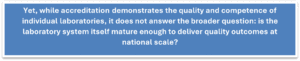
This was an essential step forward. Yet it also raises a larger question: what about the system surrounding the laboratory? Beyond individual facility performance, the effectiveness of laboratory services depends on national regulations, governance, financing, workforce capacity, network design, quality infrastructure, testing capacity, information systems, data management, and coordinated response functions. These are the elements that determine whether quality is equitably distributed, sustained over time, and resilient during crises.
That question takes us beyond accreditation and toward the concept of system maturity monitoring.
In essence, accreditation transformed trust into proof. It made laboratory quality more objective, visible, and defensible. It raised the standard for what good laboratory practice should look like.
In the next article — LMM Article #3 — we will explore how laboratory quality must extend beyond individual laboratory accreditation to encompass networks, systems, and national architecture. Ultimately, while strong laboratories are essential, it is strong laboratory systems that enable sustainable progress toward UHC and reinforce stronger global health security (GHS).
References
[1] College of American Pathologists. Historical Timeline: Establishment of CAP Laboratory Accreditation.
[2] United Kingdom Accreditation Service. UKAS at 30: a retrospective on the evolution of confidence through accreditation.
[3] Australian Government, Department of Industry, Science and Resources. National Association of Testing Authorities, Australia (NATA): Australia’s standards and conformance infrastructure.
[4] International Organization for Standardization. ISO 15189:2003 Medical laboratories — Particular requirements for quality and competence.
[5] International Organization for Standardization. ISO 15189 publication history and later revisions (2007, 2012, 2022).
[6] International Laboratory Accreditation Cooperation. About ILAC / ILAC’s Role.
[7] International Laboratory Accreditation Cooperation. Accredited conformity assessment bodies under the ILAC MRA.
[8] Yao K, et al. Improving quality management systems of laboratories in developing countries: an innovative training approach to accelerate laboratory accreditation. Am J Clin Pathol. 2010;134(3):401–409.
[9] World Health Organization Regional Office for Africa. Guide for the Stepwise Laboratory Improvement Process Towards Accreditation (SLIPTA) in the African Region. Brazzaville: WHO AFRO; 2015.
[10] Africa CDC and WHO-AFRO. LMM Assessor Manual. 1st edition, December 2025.
[11] Onyango EN, et al. Building national laboratory systems in sub-Saharan Africa: the role of clinical and public health laboratories. Afr J Lab Med. 2016.
[12] Elbireer AM, et al. The Good, the Bad, and the Unknown: Quality of Clinical Laboratories in Kampala, Uganda. PLoS ONE. 2013;8(5):e64661.
[13] Infectious Diseases Institute. Our Laboratory Impact and Reach.
[14] Uganda National Health Laboratory and Diagnostic Services. Uganda’s Laboratories Shine: NHLDS Leads the Way in Accreditation! 2024.
[15] Makokha EP, et al. Enhancing accreditation outcomes for medical laboratories on the Strengthening Laboratory Management Toward Accreditation programme in Kenya via a rapid results initiative. Afr J Lab Med. 2022;11(1):1614.
[16] Management Systems World. African Accreditation Cooperation (AFRAC). Available at: https://managementsystems.world/institution/african-accreditation-cooperation-afrac (Accessed 19 April 2026).




One Response
Cảm ơn bài viết. Với dịch vụ du học Hàn Quốc chuyên nghiệp, Letco giúp bạn tiết kiệm thời gian và chi phí chuẩn bị hồ sơ. Truy cập letco.vn để biết thêm.